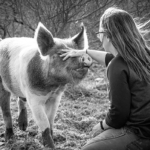
In this deeply personal and thought-provoking reflection, Dr Daniela Rizzo, Lecturer in Systematic Theology at Alphacrucis University College, explores how childhood concern for a beloved cat became the starting point for a wider theological journey. Challenging visions of salvation centred on escape from creation, she argues for a richer Christian hope rooted in the healing and renewal of all that God has made.
There are nights from my childhood that I still remember with unsettling clarity. Long after everyone had gone to bed, I would quietly move through the hallway of our house, stopping outside each bedroom door to listen for breathing. Sometimes I waited for the reassurance of a snore before returning to my own room. My parents assumed I was sleepwalking. In truth, I was afraid.
I had grown up in a Pentecostal church shaped by rapture theology, where the end of the world was never distant. Jesus could return at any moment. The faithful would disappear. Cars would crash without drivers. Clothes would remain crumpled on the floor. Those left behind would enter a world of terror and judgment.
Adults around me spoke about this with anticipation. They longed to be taken “home.”
But all I could think about was my cat.
Who would feed him if everyone vanished?
The question troubled me with an almost unbearable weight as a child. I imagined him trapped inside the house, pacing between empty rooms, waiting at the door for people who would never come back. While sermons celebrated escape from the world, I could not shake the feeling that something about this vision of salvation felt strangely loveless.
At the time, it felt blasphemous to articulate such a concern. It could easily be reduced to a childish preference for my cat over Christ, rather than recognised as a deeper unease about a theology of salvation that seemed to require abandonment. I only knew that I could not separate redemption from responsibility. Even as a child, it seemed impossible to me that divine love could culminate in desertion.
Years later, I would understand that what troubled me was not merely the exclusion of animals from heaven (as what was taught in church at the time), but the broader theological imagination beneath it: a vision of salvation that seemed to require distance from the very creation God once called good.
Much of modern rapture theology trains Christians to relate to the world as temporary and disposable. The earth becomes a waiting room for eternity rather than a sacred reality permeated with divine presence. Creation is reduced to the backdrop of a human salvation story, destined ultimately for destruction. Within this frame, animals exist at the edges of theological concern: perhaps loved sentimentally but rarely regarded as participants in the redemption story.
The spiritual significance of this is not inconsequential.
A theology of escape subtly teaches detachment and it weakens our sense of obligation toward the earth and the vulnerable lives within it. Why care too deeply for creation if it is all destined to burn? Why invest in healing a world we are supposedly preparing to leave behind?
Yet the deeper I studied theology, the more I realised how profoundly foreign this imagination is to the biblical story itself.
Scripture does not end with humanity abandoning the earth. It ends with creation renewed. In many ways, creation itself mirrors the pattern of Christ’s resurrection body: wounded yet restored, continuous with what came before yet transformed into renewed life.
The prophets envision wolves beside lambs, deserts flowering, rivers overflowing with life. Paul speaks in Romans of creation itself groaning for liberation. Revelation culminates not in souls escaping the material world, but in heaven descending into it: a restored creation where death, grief, and violence no longer reign.
The biblical vision is not evacuation… it is reconciliation!

Historically, Christian theology has often marginalised animals within eschatology (the study of the last things), treating them as symbolic ornaments while prophets and priests take centre stage. But the biblical witness repeatedly unsettles this human focus. The covenant with Noah is made not only with humanity, but with “every living creature.” Isaiah’s peaceable kingdom includes animals within restored harmony. The Psalms speak of creation praising God. Revelation imagines every creature in heaven and earth joining in worship.
The redemption envisioned in Scripture is not detached from creation but bound to its healing.
My own work as a Pentecostal theologian has increasingly been shaped by this conviction. While Pentecostalism has often inherited apocalyptic frameworks marked by urgency, fear, and escape, its theological centre contains something far more expansive: the Spirit poured out upon “all flesh.” The Spirit is not merely concerned with rescuing souls from creation, but with sustaining, renewing, and reconciling life itself.
Encouragingly, contemporary Pentecostal theology has continued to mature beyond some of its earlier escapist tendencies. Many Pentecostal theologians now emphasise restoration rather than evacuation, recognising the Spirit as actively at work within creation — healing, renewing, and drawing the created order toward reconciliation. My own research stands within this emerging movement, seeking to articulate a more creation-affirming vision of redemption grounded in relationality, renewal, and hope for the whole created world.
If Pentecost announces anything, it announces divine presence overflowing the boundaries we construct between sacred and ordinary, human and non-human, spiritual and material.
This is why I can no longer embrace forms of eschatology that require detachment from creation in order to sustain hope. Love simply refuses such abandonment.
Love changes how we imagine eternity.
If God calls creation good, if creatures matter to God, if our relationships with vulnerable beings shape us morally and spiritually, then redemption cannot mean celebrating our escape while the rest of creation is left behind. A salvation that trains us not to care for the vulnerable is not merely emotionally unsatisfying; it is theologically disordered.
I do not claim certainty about what eternity looks like, nor can I map the mechanics of the new creation. But I no longer believe Christian hope is about departure from the world.
The deeper I have travelled into theology, the more convinced I have become that redemption is not the abandonment of creation, but its healing.
And perhaps that frightened child wandering the hallway at night understood something essential long before I ever learned to articulate it academically: that love, if it is truly love, does not leave animals behind.
Dr Daniela Rizzo is a Lecturer in Systematic Theology and Director of Higher Education Diplomas in Leadership and Ministry at Alphacrucis University College, Australia. She recently completed her PhD, Theological Foundations for a Pneumatology of Animals, and is the author of the new book Animal Pneumatology, the first systematic theological exploration of the Holy Spirit’s relationship with non-human creatures.
Her research focuses on animal theology, pneumatology, creation, and the relationship between God and the more-than-human world.