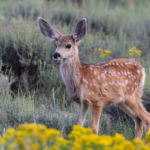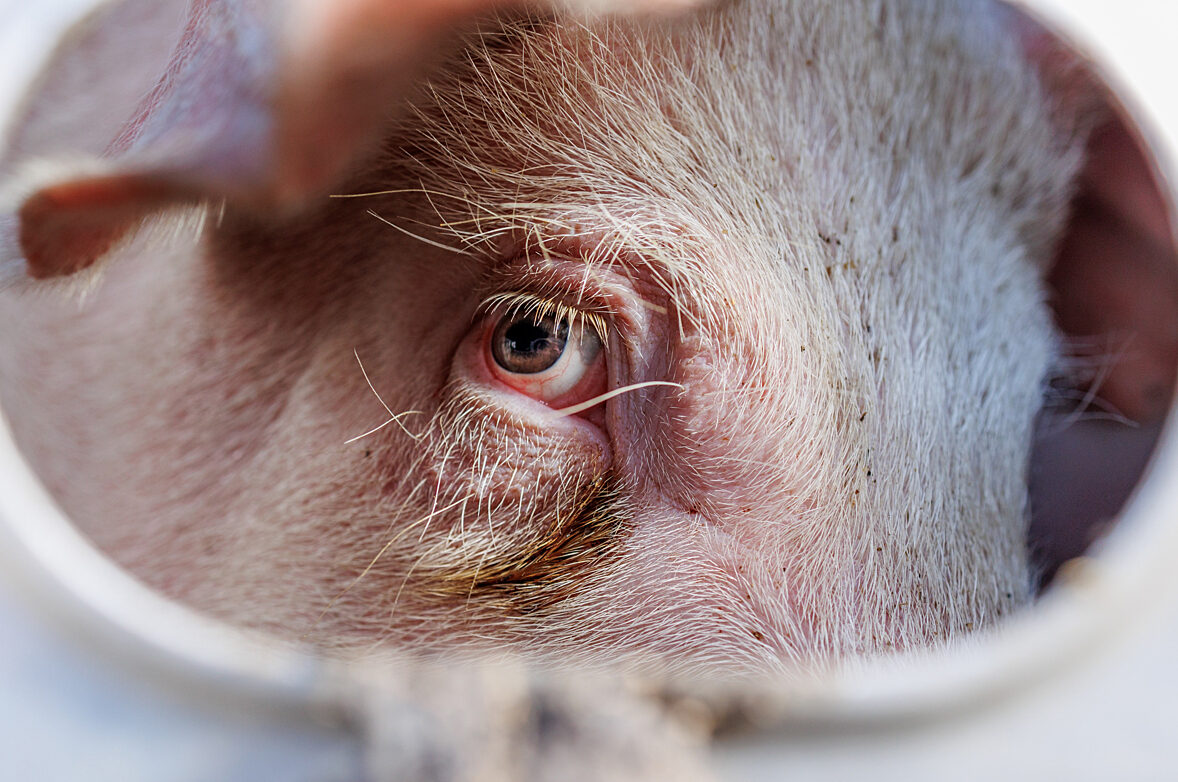
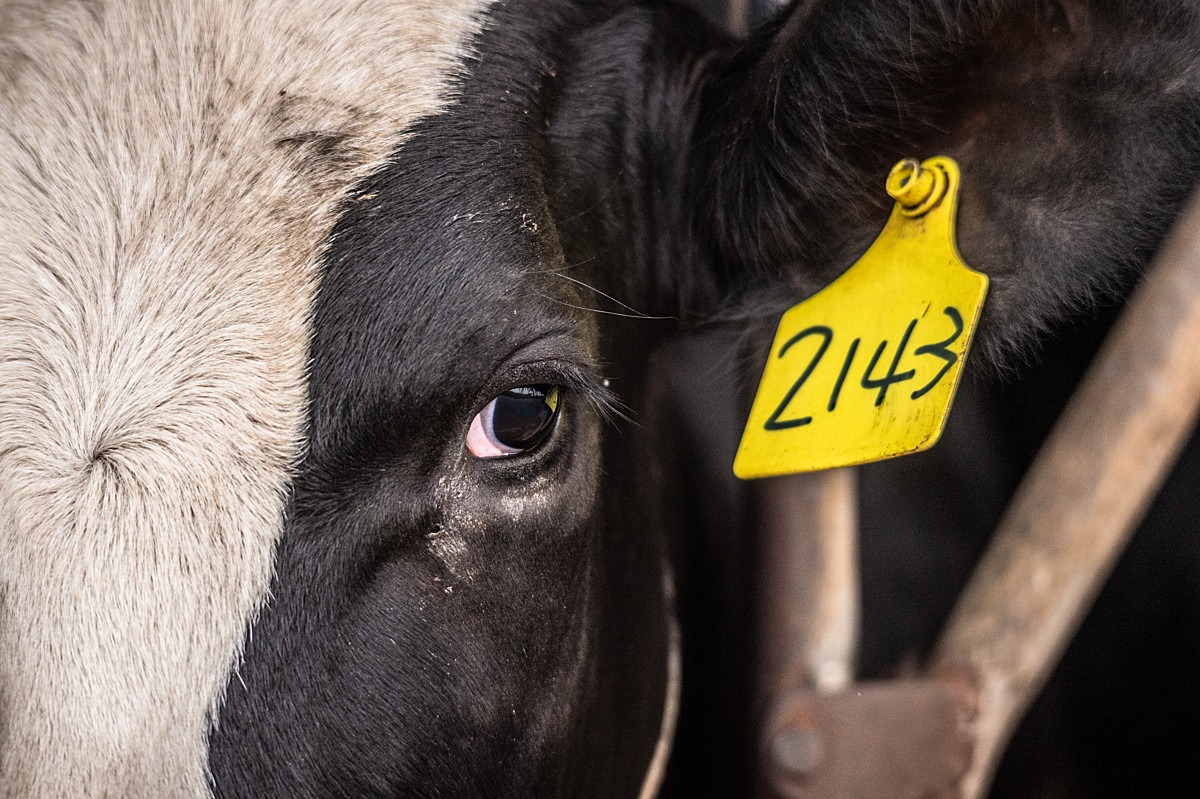
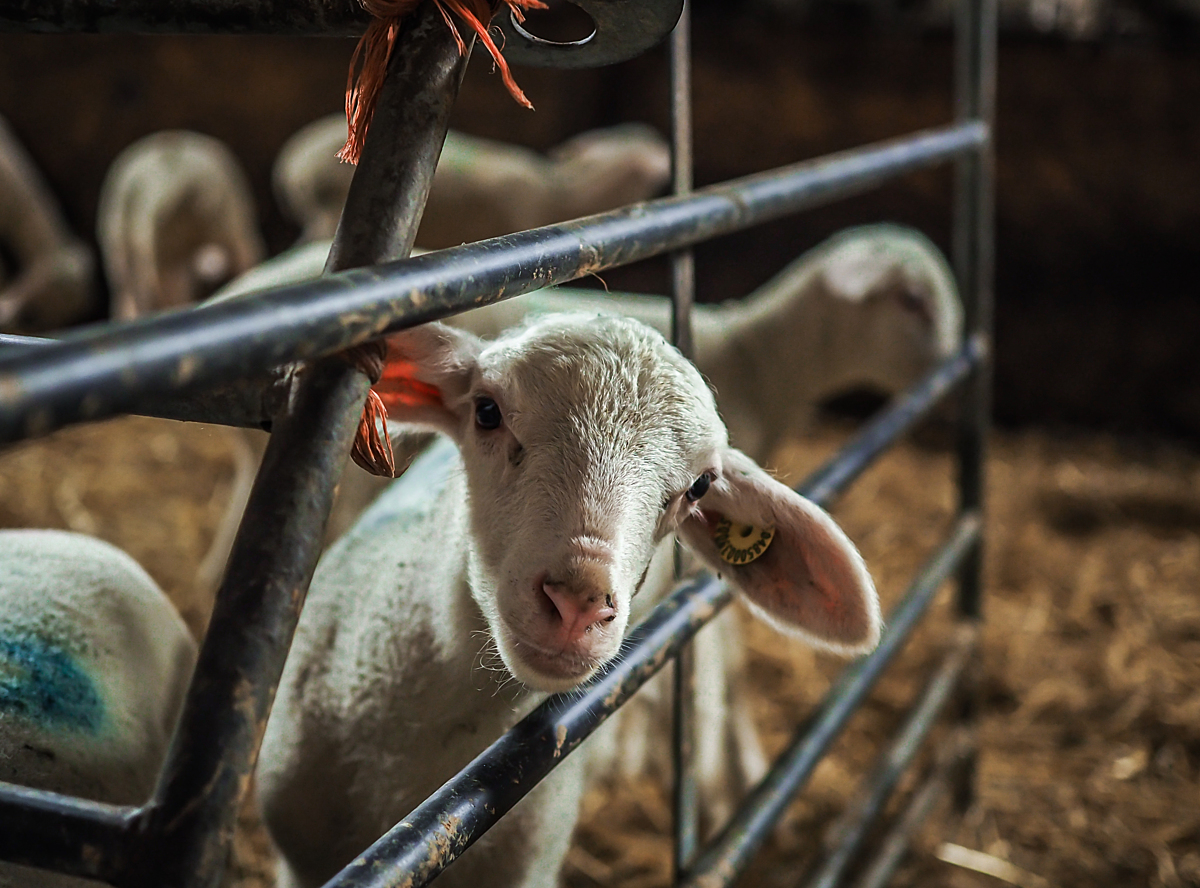
When we look into the frightened eyes of an intensively farmed animal, what do we see?
Speaking at the University of Pennsylvania’s Penn Humanities Forum, the philosopher Slavoj Žižek gives an unsettling answer. We might assume that the question concerns animal consciousness: what does the animal feel, know, fear or understand? But Žižek turns the question around. The deeper question is not only what we see in the animal, but what the animal’s gaze reveals about us. In the gaze of the frightened animal, Žižek says, ‘you see your own monstrosity.’
It is a severe thought. Perhaps too severe, at first. Most of us do not think of ourselves as monstrous. We think of ourselves as ordinary people trying to live decent lives. We care for our families, go to work, recycle when we remember, offer kindness where we can. We may even love animals deeply, especially the animals we know by name.
And yet, beyond the reach of ordinary sight, billions of animals live and die within systems shaped by human appetite, profit and convenience. Their bodies are bred, confined, altered, tested, transported and killed. We know this, or at least we know enough. But the knowledge is managed. It is softened by language, hidden by distance and neutralised by habit. We know, and yet we live as though we do not know.
Žižek’s provocation matters because it suggests that animal suffering does not only reveal something about animals. It reveals something about us.
Oscar Wilde’s The Picture of Dorian Gray offers a vivid image of this kind of moral revelation. Dorian remains outwardly beautiful while his hidden portrait bears the marks of his corruption. The life he presents to the world stays charming and untroubled, but somewhere out of sight the truth is becoming increasingly unbearable. At one point, Wilde writes: ‘His own soul was looking out at him from the canvas and calling him to judgement.’
That is what the portrait does. It shows him what he has become.
This is why Dorian hides it. The portrait must not be seen. Its horror is not only that it is ugly, but that it is truthful. It reveals what polite society, personal charm and outward respectability can conceal.
There is a troubling parallel here with our treatment of animals. Modern life remains outwardly clean, efficient and civilised. Supermarket shelves are tidy. Laboratory language is clinical. Menus are elegant. Leather is stylish. The violence is elsewhere. It is kept behind walls, in sheds, in transport crates, in slaughterhouses, in laboratories and in the carefully managed invisibility of industrial life.
Like Dorian Gray, we do not destroy the portrait. We hide it.
The suffering animal becomes, in this sense, a kind of portrait of human distortion. Not because animals exist to teach us moral lessons, and not because their suffering should be reduced to symbolism. Their suffering is real in itself and matters to God. But it also reveals something about what happens to human beings when power is severed from compassion, when appetite is detached from restraint and when creation is treated as raw material for our desires.
This is where Christian theology can take us deeper than moral shock alone.
The Bible tells us that human beings are made in the image of God. Too often, this has been treated as a badge of superiority, as though being made in God’s image means standing above other creatures with unchecked authority. But if the God whose image we bear is revealed in Jesus Christ, then the image of God cannot mean domination without love. It cannot mean mastery without mercy. It cannot mean the right to use the vulnerable simply because we can.
In Christ, divine power is revealed as self-giving love. The Lord of creation comes among us not as a tyrant, but as servant. He touches the wounded, welcomes the overlooked and gives himself for the life of the world. If this is the true image of God, then cruelty to animals is not merely a failure of kindness. It is a distortion of our human vocation.
Matthew Halteman, Professor of Philosophy at Calvin University in Grand Rapids, Michigan, expresses this well when he writes that human beings are called ‘not to be domineering lords and masters of other creatures, but rather to serve as their benevolent caretakers and companions.’ That vision cuts against the grain of much modern life. We have been trained to see animals through categories of use: food, fabric, experiment, entertainment, pest, stock, specimen. Christianity invites a different form of vision. It asks us to see creatures first as God sees them: living beings sustained by divine generosity, belonging not ultimately to us, but to God.
Jesus says in Matthew’s Gospel: ‘The eye is the lamp of the body. If your eyes are healthy, your whole body will be full of light.’ The eye, here, is not only about physical sight. It is about moral and spiritual perception. What we are willing to see, and what we refuse to see, shapes the whole person.
This is one reason animal suffering is so spiritually dangerous. Not only because of what it does to animals, though that is terrible enough, but because of what our refusal to see it does to us. If we keep animal suffering hidden away in the dark, it is not only the animals who are concealed. Something in us is darkened too.
The locked room of Dorian Gray’s portrait becomes a powerful image of moral disavowal. We place the signs of our violence out of sight, then continue living as though the portrait does not exist. But the Christian life cannot be built on hiddenness of this kind. Confession begins when we allow truth to come into the light.
This does not mean despair. The gospel never invites us merely to stare at the portrait in horror. The good news invites us to repentance, healing and restoration. If the image of God in us has been distorted, it has not been destroyed. In Christ, humanity is not abandoned to its violence. We are called back to our true vocation: to reflect God’s care, generosity and peace within creation.
This is why Christian concern for animals should not be dismissed as sentimentality. It is not a distraction from serious faith. It is one place where serious faith becomes visible. The way we treat vulnerable creatures tests what we really believe about power, mercy, creation and the God whose image we bear.
Nor is this about moral purity. Many Christians feel overwhelmed by the scale of animal suffering and by their own complicity in systems they did not create. That feeling is understandable. But Christian discipleship is not the achievement of spotless innocence. It is a journey of conversion. It is learning, step by step, to bring more of life into alignment with the mercy of God.
For some, that may mean moving towards veganism. For others, it may begin with refusing particular products, asking harder questions, praying differently, supporting animal protection work or simply allowing themselves to see what they have previously avoided. These may seem small acts beside the vast machinery of animal exploitation. But they are not meaningless. They are ways of refusing the lie that living creatures are merely things. They are ways of letting light back into the eye.
Halteman speaks of a ‘shalom-filled creation’, a world of peace, justice and creaturely flourishing. Christians do not yet live in that world fully. But we are called to live towards it. We are called to become signs of it. We are called to be people whose lives give some glimpse, however partial and imperfect, of the reconciliation God promises for all creation.
So perhaps Žižek is right. Perhaps in the eyes of the frightened animal we do see something of our own monstrosity. But Christians need not end there. The gaze that exposes us can also awaken us. The portrait we hide can become the beginning of confession. The darkness we have tolerated can be brought into light.
The question is not only what we have done to animals.
It is what our treatment of animals reveals about what we have become, and what, by the grace of God, we may yet become.
Written by the Sarx editorial team