Catholic priest Fr Terry Martin reflects on the Church’s teaching about animals and asks whether it has gone far enough in confronting the realities of factory farming. Drawing on Laudato si’, Catholic theology and his recent correspondence with the Vatican, he argues that animals must be taken more seriously within the Church’s moral life.
Laudato si’ reached its tenth birthday last year. A landmark document from Pope Francis, it was the first encyclical of its kind: seeking, with the full authority of the Church, to ask serious questions about the climate crisis which we are currently all experiencing.
As a Catholic priest, I have spent a long time examining the document and reflecting prayerfully on all that it says. Such a document is very high up in the Catholic scheme of things and, as far as papal proclamations go, it carries a lot of weight. An encyclical forms what Catholics call the ordinary magisterium—that is to say, its contents become an official part of the doctrine and teaching of the Church. As such, this teaching is not an optional extra for Catholics. When popes promulgate encyclicals, they do so with care and with conviction, because of the authoritative nature of such teaching.
With the news of the incoming original document all those years ago, I had hoped that at last the Church was going to get serious about animals and about the planet, and to inform Catholics of our responsibility to “care for our common home” (the subtitle of the encyclical). Among animal-regarding Catholics and Christians, the text was greatly anticipated, raising lots of hope and engendering much enthusiasm. Perhaps finally, we dared to believe, we will hear the Church’s confident and historic voice calling for an acceptance and understanding that animals are, like us, created by God and deserve, because of that reality, to be treated accordingly, and not simply seen as objects with which humans can do what they like. Eleven years on, it seems that this important and ground-breaking document from Pope Francis has, like so many before it, been shelved and quietly (but respectfully, of course) forgotten.
In the world of Christian animal advocacy, particularly from my specifically Catholic viewpoint, the progress since Laudato si’ has nevertheless been disappointing. That’s a shame. In 2022, in the light of Laudato si’, the Catholic bishops of England and Wales revised and updated their own document on the environment, The Call of Creation. Subsequently, in 2023, Pope Francis issued an Apostolic Exhortation (which, incidentally, has a lower status than an encyclical) entitled Laudate Deum, building on the work begun in the 2015 encyclical.

It would seem to me, as a priest who loves both the priesthood and the Church, that none of these documents goes quite far enough in confronting what our theology of creation means for the animals themselves. Laudato si’ contains some remarkably strong affirmations. Pope Francis rejects a ‘tyrannical anthropocentrism’ that is unconcerned with other creatures, insists that other living beings have ‘a value of their own in God’s eyes’, challenges the idea that they exist simply for human use and calls us to understand human dominion as responsible stewardship. Yet, in my view, these principles have not been followed through sufficiently into the Church’s moral thinking about individual animals and the systems in which they are raised, used and killed. What, for example, does it mean to recognise the God-given value of a pig or a chicken when considering factory farming and industrial slaughter? Animals are more than part of the backdrop to the human ecological crisis. They are creatures of God in their own right and I believe the Church needs to say much more clearly what follows from that.
The gospel is Good News for the whole of creation. This Good News transforms and redeems all things. I do not consider it ‘un-Catholic’ (although many would) to believe that God, in his goodness, having first created animals to share with us this beautiful planet, can (and would) provide for them (as well as us) in his great plan of salvation and redemption. Daily, as I celebrate Mass, I find myself proclaiming the words I’ve said so many times before, when addressing God the Father: “… all you have created rightly gives you praise, for through your Son our Lord Jesus Christ, by the power and working of the Holy Spirit, you give life to all things and make them holy …” (Eucharistic Prayer III, Roman Missal). These words are precise and clear. The liturgical prayers which are used for Mass in the Catholic Church are scrutinised and carefully composed, so as to ensure that they remain theologically sound and proclaim only that which the Church believes to be true. There can be no room for misunderstanding or erroneous interpretation in such texts. These words, then, are not incidental. They sit at the very heart of the Mass—the supreme action of Christian worship. They matter. Later in the same prayer, I pray, “May this Sacrifice … advance the peace and salvation of all the world”. Again, there’s no mistaking the meaning here. The whole of creation is ordered to be a participant in Christ’s redeeming work—not just you and me! The Good News is for each and all, human and non-human animal. As many readers will know, there are a number of very helpful scripture passages which help to promote and undergird this view.
With all that in mind, I had hoped, with so many, that Laudato si’, The Call of Creation, and Laudate Deum would move the conversation forward for animals in terms of Catholic faith. That hasn’t happened (apart from a few very hopeful shoots of new life). It is true that more Catholic commentators and theologians are tackling some of the issues around animals, and they are asking the necessary questions of their fellow believers. I am so grateful to them. In all of this, I, too, have tried to make a tiny contribution, in as far as I am able. I am not a scholar or an academic, but I am able to use a small degree of influence in that I am a priest of the Church. As other Christian animal advocates will know, it’s an uphill struggle, and what seems so obvious to us is yet to become apparent in the minds and hearts of the majority.
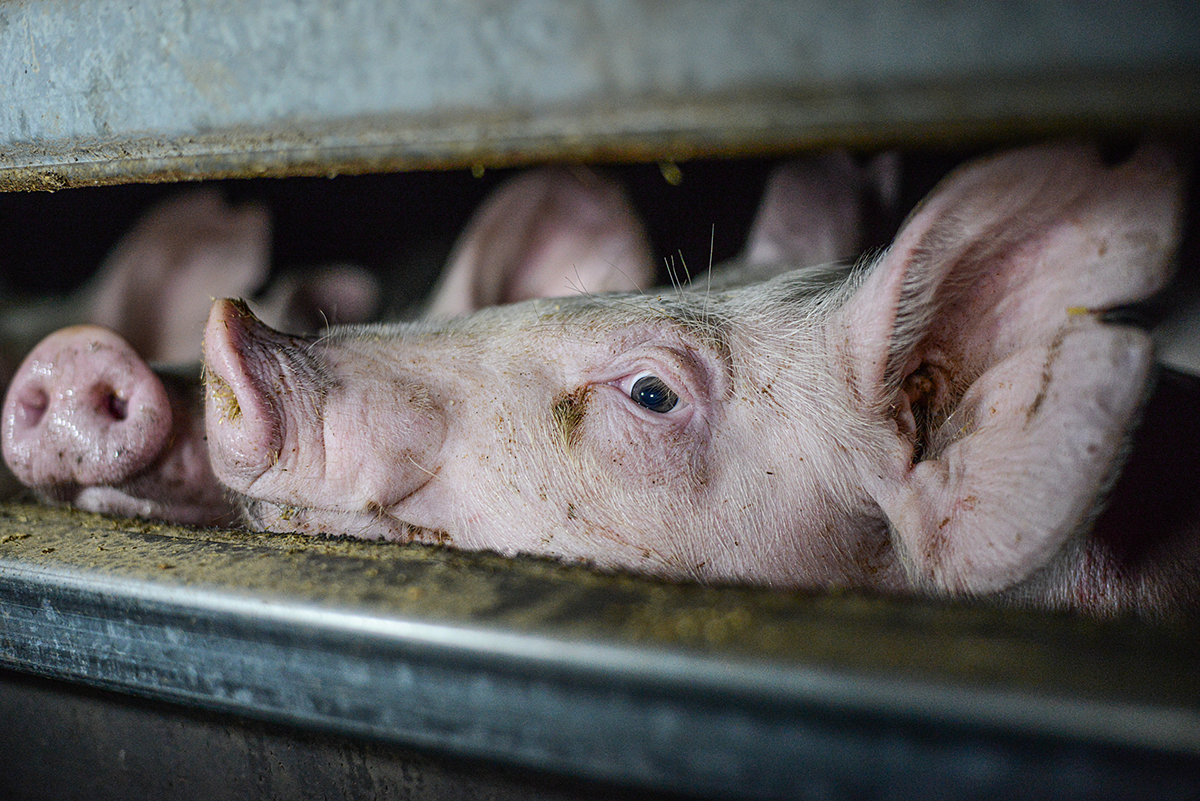
Recently, I wrote a carefully worded letter to the Vatican. The governance of the Church is complex and many-sided but, in my letter to the Dicastery for Promoting Integral Human Development, I asked if the Church might address modern issues of industrial agriculture and, to make my point, focused, in this instance, on the horrific gassing of pigs with CO₂. The use of high-concentration CO₂ is a shocking practice and has been criticised because of the severe distress pigs can experience before losing consciousness. In effect, I am urging the Church to engage more energetically and consciously with animal ethics, to look beyond the ingrained habit and tendency of anthropocentrism and, instead, to see animals for who they truly are under God. In the correspondence, I make the point that much real work needs to be done by the Church around this developing area. Additionally, I state that the Church has not traditionally developed much teaching in the field of animal ethics, and I want to vehemently urge the hierarchy that it’s time that we did. Laudato si’, The Call of Creation, and Laudate Deum all call for responsible stewardship of the planet and reverence for creation. It is my view that this particular method of pig slaughter—and, regrettably, so many other similar practices— flies in the face of such reverence and stewardship. I have asked the dicastery to set up working parties to look at creation care and related Christian ethics; to propose guidance to the faithful regarding the moral implications of practices like factory farming; and to offer greater honesty and transparency to the faithful in how these methods of ‘food production’ are described and understood.
The Church wants to speak the gospel into the contemporary world. The Church’s understanding and application of Christian teaching develops as it encounters new circumstances. Animals surely deserve more than a passing glance when it comes to the way that we raise, slaughter and eat them.
Perhaps I’d have been better approaching my own bishop and asking him for a similar working group in our own diocese. In fact, when he arrives (as we’re waiting excitedly for a new shepherd), I may well do that. The Vatican is a large, slow-moving entity … but, it seems to me, that Pope Francis has already opened the discussion at the highest levels of the Church. I am hoping that we can build and develop on that initiative. Animals matter to God. Animals surely matter to Christians too. I invite the Church to address these issues urgently.
Fr Terry Martin serves as a supply priest in the Roman Catholic Diocese of Arundel & Brighton. A committed vegan and advocate for animal rights, he integrates his faith with a compassionate approach toward all creatures.
Explore his latest book, Animals in Heaven?, and purchase a copy here.